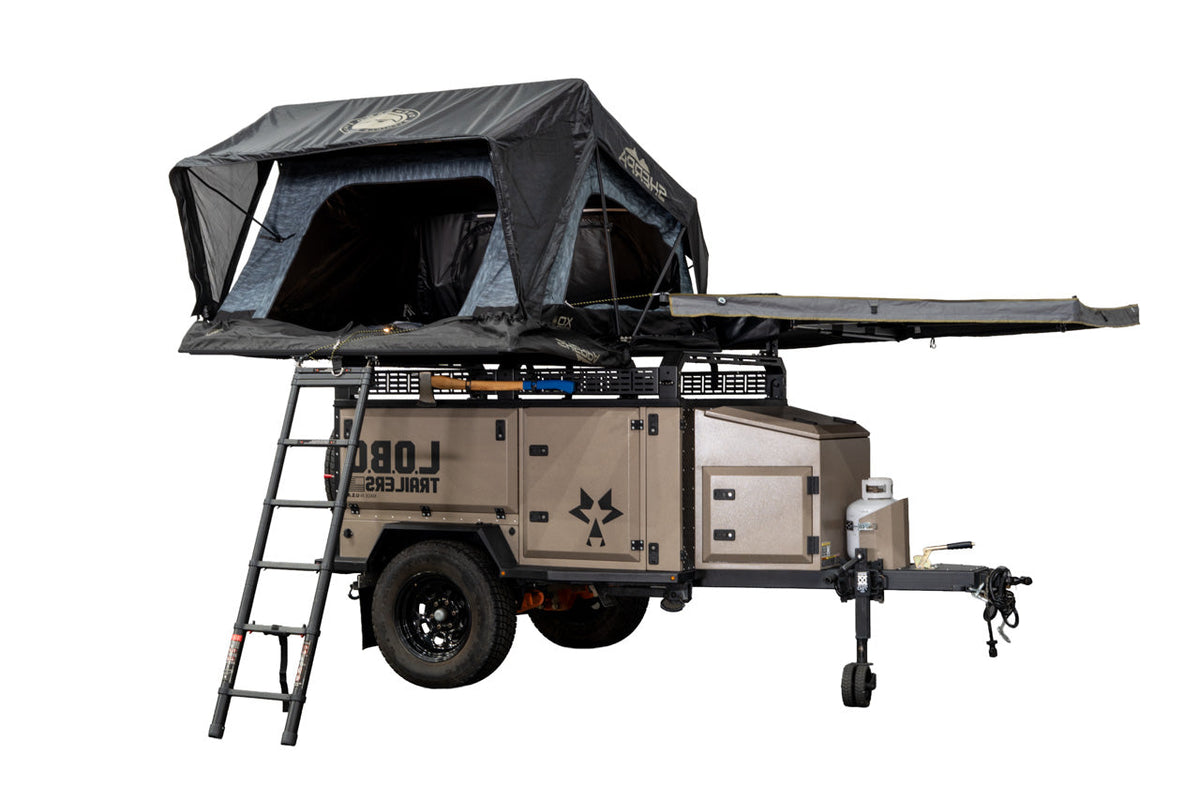
Plenty of trailers are sold as "off-road." Fewer are built for washboard, rutted two-track and the rocky climbs that come before the best campsites. If you're shopping for an off-road camper trailer, the badges and the brochure photos won't tell you much. What's under the box will.
We build L.O.B.O. Adventure Trailers to order in Corona, California, and we get the same questions from nearly every buyer. This guide covers what we tell them: what to check, what to ask, and how to match a trailer to the way you travel. It works whether you're looking at our trailers or comparing builders like Patriot Campers, Turtleback, Sasquatch or Xventure.
What Makes a Camper Trailer "Off-Road"?
An off-road camper trailer is built to follow a capable 4x4 down dirt roads and trails without slowing it down, breaking, or shaking your gear apart. In practice, that comes down to five things: suspension, clearance, hitch articulation, tires and brakes, and a structure that can take hard miles for years. Tents, awnings and kitchens matter, but they bolt on. The foundation doesn't.
1. Suspension: Start Here
The suspension controls how the trailer tracks behind you, how much it bounces, and how hard your gear and cabinets get hit on every rough mile.
Independent vs. solid axle
Many basic trailers use a solid axle on leaf springs. It's simple and cheap, but a bump on one wheel moves the whole axle. With independent suspension, each wheel moves on its own, which usually means better tracking and a smoother ride for whatever you're carrying.
Every L.O.B.O. Alpha-platform trailer rides on Cruisemaster CRS2 independent suspension with 5 inches of listed suspension travel. That's the same on the Alpha, the Alpha Pro and the Alpha Pro Max. The higher models add equipment, not a different chassis.
Questions to ask any builder
- What suspension does it use, and who makes it?
- How much travel does it have?
- Is the suspension the same across models, or does the entry model get less?
2. Ground Clearance and Departure Angles
Clearance decides whether the trailer clears the rock your truck just drove over. A trailer that drags its belly or water tank is a trailer you'll leave at home. The L.O.B.O. Alpha platform lists 22.5 inches of clearance.
Clearance isn't only the number at the axle. Look at what hangs lowest: water tanks, propane, spare tire mounts, steps. Then look at the trailer from the side and think about how it will clear a sharp dip or a creek-crossing exit.
3. The Hitch: Articulation Matters More Than You Think
A standard ball coupler is fine on pavement. Off-road, when your truck and trailer are twisted at different angles, a ball can bind or hit its limits. An articulating hitch lets the trailer roll and pitch independently of the vehicle.
L.O.B.O. trailers use a Lock N' Roll 360° articulating hitch, and the trailer pages list it as a coupler upgrade option alongside the Max Coupler. Whatever trailer you buy, ask what the hitch is rated for and how far it articulates.
4. Weight: Know What You'll Actually Tow
Every trailer looks light in the brochure. The numbers that matter are:
- Dry weight: the empty trailer.
- Loaded weight: with water, gear, food, fuel and accessories.
- Tongue weight: the downward load on your hitch.
The Alpha platform lists a 1,750 lb dry weight, an estimated 2,700 lb loaded weight and a 285 lb tongue weight. Check those numbers against your vehicle's towing capacity, payload and hitch rating in the owner's manual. Remember that tongue weight counts against payload, along with the people and gear in the cab.
5. Tires, Wheels and Brakes
Match your trailer's tires to your tow vehicle if you can. One spare then fits both, which matters a lot when you're far from help. L.O.B.O. trailers roll on 265/70R17 all-terrain tires and wheels with electric brakes and a parking hand brake. On steep descents, trailer brakes keep a loaded trailer from pushing your truck.
6. Storage You Can Live With
Liters on a spec sheet are less important than how the space is divided. On day three of a trip, you want to reach the coffee without unloading the recovery gear.
The Alpha platform lists 13 storage zones and 2,800 liters in total, including a heavy-duty 3-drawer rear storage system, front box bulk storage, and mid-box storage for a table and chairs. Ask any builder to open every door and show you where the kitchen, water, recovery gear and clothes would go.
7. Water, Power and Kitchen
Water
The longer you stay out, the more water drives your trip. Every Alpha-platform trailer carries a 35-gallon baffled stainless steel water tank with a 12V, 3 GPM pump. The baffles keep water from sloshing hard as you drive.
Power
Look at battery chemistry and capacity, charging sources, and how you'll monitor it all. The Alpha includes REDARC Rogue power management with shore, solar and tow charging, and a 1000W Renogy inverter. Lithium and higher-output inverter upgrades are available. The Alpha Pro comes with a Renogy 200 amp lithium battery, and the Pro Max steps up to a REDARC 2000W Pro Series inverter.
Kitchen
A pull-out kitchen that's ready when you stop makes camp feel easy. The Alpha has a chef-style L-shape kitchen pull-out with a hot/cold faucet, and the Pro Max adds a Dometic stainless stove and sink combo. You can also see camp-kitchen gear in our overland gear and accessories collection.
8. Built to Order vs. Off the Lot
An off-the-lot trailer comes the way the factory specced it. With a built-to-order trailer, you choose the tent, awning, fridge and power that fit your trips, and you skip paying for gear you already own. The tradeoff is time: you wait for the build. For a trailer you plan to keep for years, most buyers think that's worth it.
At L.O.B.O., you can pick your starting point:
- Alpha: for overlanders who already own quality gear and want a trailer built to carry it.
- Alpha Pro: our most popular setup. It comes with a four-person soft-shell rooftop tent, 270° awning, IceCo dual-zone fridge, 200Ah lithium power and a Joolca hot water heater.
- Alpha Pro Max: adds an OVS XD Everest hard-shell rooftop tent, Taruca Rogue 270° tri-color awning, REDARC 2000W inverter and Dometic stainless stove and sink.
A Quick Off-Road Camper Trailer Checklist
- Independent suspension from a known manufacturer, with published travel.
- Ground clearance that matches or beats your tow vehicle's.
- An articulating off-road hitch.
- Loaded and tongue weights that fit your vehicle's ratings.
- Tires that match your truck's size.
- Electric brakes plus a parking brake.
- Organized storage zones, not just total volume.
- Water and power sized for your longest trip.
- A builder you can call, and a trailer you can see in person.
Frequently Asked Questions
What is the difference between an off-road camper trailer and a regular camper?
A regular camper is built for paved roads and campgrounds. An off-road camper trailer has more clearance, off-road suspension, an articulating hitch and all-terrain tires, so it can follow a 4x4 on dirt roads and trails.
Do I need independent suspension on an off-road trailer?
If you'll drive rough dirt roads often, independent suspension is worth prioritizing. Each wheel moves on its own, which usually improves tracking and reduces the beating your gear and cabinets take. Every L.O.B.O. Alpha-platform trailer uses Cruisemaster CRS2 independent suspension.
How heavy is a L.O.B.O. off-road camper trailer?
The Alpha platform lists a 1,750 lb dry weight, an estimated 2,700 lb loaded weight and a 285 lb tongue weight. Always check these against your own vehicle's ratings.
Can I see a trailer before I order?
Yes. Our shop is at 803 E. Parkridge Ave., Corona, CA 92879, open weekdays 9am–4pm by appointment. Call or text (951) 888-0043 to book a walkaround, or contact us to see a build in person.
See One in Person
The best way to judge an off-road camper trailer is to stand next to one, open every door and look underneath. Call or text us at (951) 888-0043 or send us a message to set up a walkaround at our Corona shop. We'll help you figure out which setup fits your rig and your trips.